
5 Steps to Analyze Author's Intent on SAT
Want to ace author's intent questions on the SAT? Here's how:
- Read the entire passage first: Understand the main idea and purpose.
- Spot key words: Look for opinion words (e.g., “important,” “inspiring”), repeated ideas, and signal words like “however” or “therefore.”
- Check the tone: Identify the writer's attitude - formal, persuasive, neutral, or critical.
- Analyze structure: Break the passage into sections (opening, middle, end) and look for reasoning patterns like problem-solution or cause-effect.
- Practice questions: Focus on main purpose, specific sections, and evidence-related questions. Eliminate wrong answers by checking for tone and intent mismatches.
Quick Comparison Table
| Step | Key Focus | Example Tools/Clues |
|---|---|---|
| Read Full Passage | Understand main idea and purpose | Titles, opening/closing sentences |
| Spot Key Words | Opinion, repetition, signals | “Important,” “however,” “therefore” |
| Check Tone | Writer’s attitude | Neutral, persuasive, critical |
| Analyze Structure | Passage flow and patterns | Problem-solution, cause-effect |
| Practice Questions | Purpose and evidence analysis | Eliminate tone/intent mismatches |
Pro Tip: Spend 20-30 minutes daily practicing these steps. Tools like ChatSAT can help you refine your skills with tailored exercises and feedback.
4: Author's Intent Questions
Step 1: Read the Full Passage First
Start by reading the entire passage to get a clear understanding of the main idea and the author's purpose.
Identify the Text Type
SAT passages generally fit into one of three categories:
| Text Type | Characteristics | Purpose |
|---|---|---|
| Story-telling | Includes characters, plot, and a narrative flow | Meant to entertain or illustrate |
| Argument-making | Features claims, evidence, and persuasive language | Aims to convince or persuade |
| Fact-sharing | Focuses on data, definitions, and explanations | Designed to inform or educate |
Pay attention to how the passage is structured. Story-telling passages often follow a timeline, argument-making texts present claims supported by evidence, and fact-sharing passages group information by topic or priority.
Spot Clues About Purpose
The title, opening sentences, and concluding lines often reveal the author's intent. For instance, a title like "The Overlooked Benefits of Urban Gardens" suggests an argument-making passage that will provide evidence in favor of urban gardening.
Highlight Key Sections
Underline important terms like 'argues' or 'illustrates,' note main ideas, and mark any shifts in tone. These annotations will help you understand the passage better. Tools like ChatSAT can assist with exercises designed to improve these skills and adapt to your needs.
Once you've annotated for purpose and tone, you're ready to focus on identifying key words and phrases in the next step.
Step 2: Find Key Words and Phrases
Once you've read the passage, focus on identifying specific words and phrases that shed light on the author's intent.
Look for Opinion Words
Opinion words help reveal the author's perspective and emotions about the topic. Watch for:
| Word Type | Examples | Purpose |
|---|---|---|
| Value Judgments | crucial, important, necessary | Highlights significance |
| Emotional Terms | devastating, inspiring, shocking | Expresses feelings |
| Comparative Words | better, worse, superior | Shows preference |
| Certainty Words | clearly, obviously, undoubtedly | Signals strong conviction |
These types of words often indicate the author is expressing a viewpoint rather than just presenting facts.
Pay Attention to Repeated Ideas
Notice any concepts or phrases that come up multiple times. Repetition often serves to:
- Highlight key arguments
- Strengthen evidence
- Establish thematic links
- Reinforce the main message
For example, if "urban renewal" is mentioned several times in a passage about city planning, it likely points to a core focus of the argument.
Recognize Signal Words
Signal words can help you understand the author's goals and how they structure their ideas:
| Signal Type | Common Words | Author's Goal |
|---|---|---|
| Argument | therefore, consequently, thus | Draw logical conclusions |
| Contrast | however, although, despite | Present opposing viewpoints |
| Support | furthermore, additionally, moreover | Add to earlier points |
| Example | for instance, specifically, such as | Provide illustrations |
ChatSAT includes exercises to sharpen these skills and make identifying such patterns easier.
Next, you'll evaluate the tone in Step 3.
sbb-itb-a0f4a21
Step 3: Check the Writing Tone
Tone helps reveal the writer's attitude and purpose. It shows how authors approach their subject and audience, offering clues about the passage's intent.
Identify Tone Style
The writer's word choice and language patterns give away the tone. Here are some common tone styles:
| Tone Style | Key Characteristics | Common Context |
|---|---|---|
| Academic | Uses technical terms, formal language | Scientific texts, research papers |
| Persuasive | Includes strong adjectives, rhetorical questions | Opinion pieces, editorials |
| Objective | Neutral language, balanced presentation | News reports, historical accounts |
| Critical | Features skeptical phrases, counterarguments | Reviews, analysis pieces |
Pay attention to descriptive words, sentence structures, technical terms, and the use of personal pronouns to pinpoint the tone.
Track Tone Changes
Writers often adjust their tone to emphasize key points. Here’s what to look for:
- Contrast words: Words like "however", "nevertheless", or "despite" signal a shift.
- Time markers: Phrases like "initially", "later", or "ultimately" show progression.
- Emphasis shifts: Moving from general ideas to specific details.
- Perspective changes: Switching between personal and objective viewpoints.
For example, an author might start with neutral facts and then move into a more passionate argument. These shifts help underline important points and strengthen the main message.
Practice exercises can help you get better at spotting these tone variations and understanding how they add meaning.
Next, we’ll look at how ideas are connected in Step 4.
Step 4: Study How Ideas Connect
Understanding how ideas are linked helps uncover the author's approach and purpose.
Map Main Parts
SAT passages are structured with intention. Break them down into these main sections:
| Section | Purpose | What to Look For |
|---|---|---|
| Opening | Sets the stage | Introduction of the main topic and background details |
| Middle | Builds the argument | Evidence, examples, and explanations that support the main points |
| Ending | Wraps up the message | Conclusions, takeaways, or a call to action |
Pay attention to:
- Topic sentences that summarize the main idea of each paragraph
- Transition words like "furthermore" or "consequently"
- Placement of evidence throughout the passage
- Concluding statements that tie back to the central argument
Once you've identified these elements, look for patterns that connect them.
Find Reasoning Patterns
Recognize common reasoning patterns to better understand the passage:
-
Problem-Solution Pattern
Look for a clear description of a problem or challenge, any proposed solutions, and which solution the author leans toward. -
Cause-Effect Pattern
Identify what sets events in motion, observe how these causes lead to outcomes, and note any ripple effects or longer-term consequences.
Spotting these patterns can help you anticipate the passage's flow and overall purpose.
Step 5: Work Through Sample Questions
Build on your earlier analysis of key words, tone, and connections between ideas by practicing with sample questions.
Answer Purpose Questions
When tackling purpose questions, keep these elements in mind:
| Question Type | What to Look For | Common Question Stems |
|---|---|---|
| Main Purpose | The overall message and structure | "The primary purpose of the passage is to..." |
| Local Purpose | The function of specific sections | "The author includes [detail] primarily to..." |
| Evidence Purpose | The role of cited examples | "The data in lines 15-18 serves mainly to..." |
Start by identifying the type of question. Then, use the analysis techniques from earlier steps to find evidence that supports your answer. Once you've determined the purpose, narrow down your options quickly.
Rule Out Wrong Answers
To eliminate incorrect choices, look for options that:
- Conflict with the passage's tone
- Emphasize minor details instead of main ideas
- Suggest purposes not backed by evidence
- Fail to align with the author's intent
Apply these strategies during practice to sharpen your accuracy.
Practice with ChatSAT
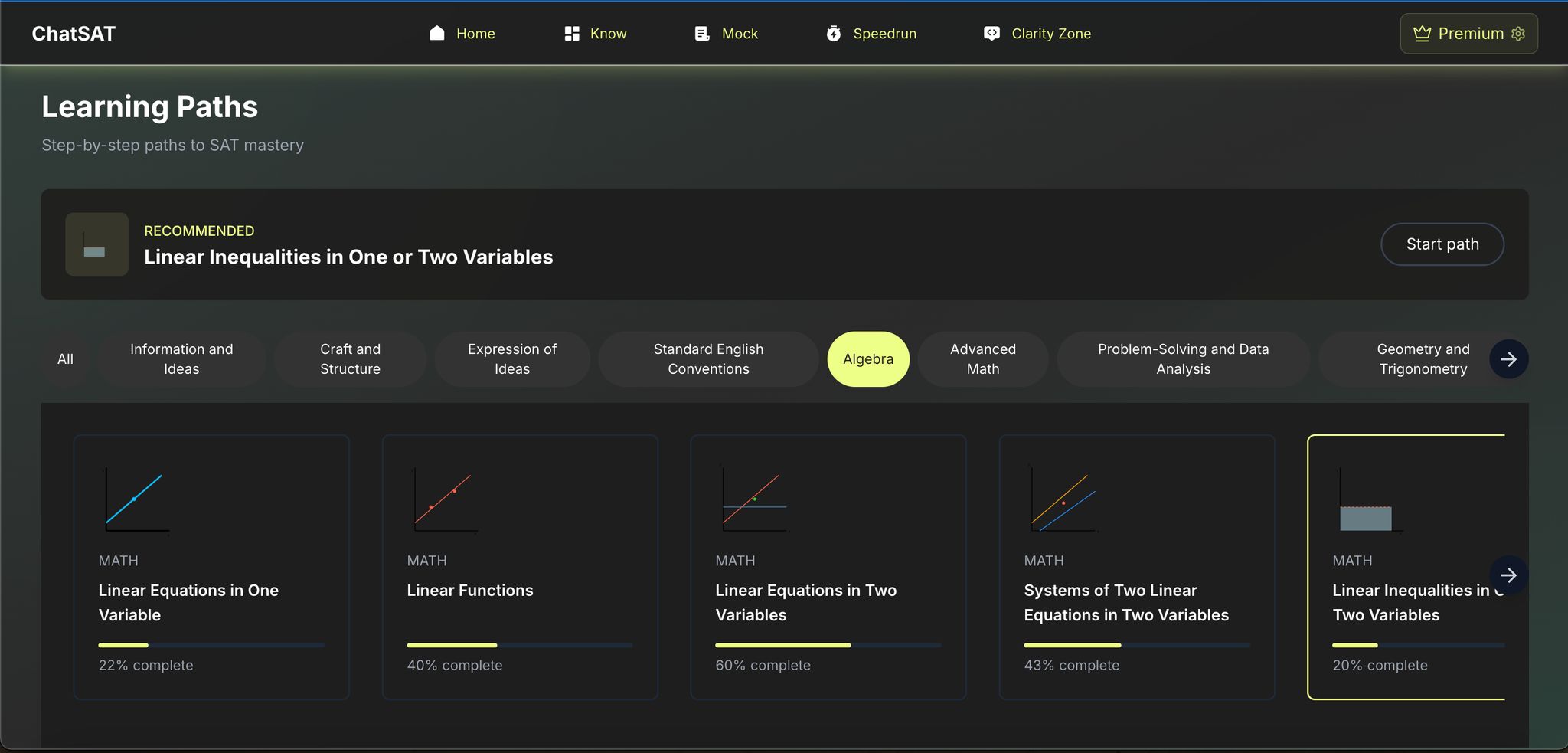
ChatSAT's practice tools can help you refine your skills:
- Start with focused practice: Begin with targeted exercises on author's intent questions. Use the smart review system to analyze your answers and learn from mistakes.
- Track your progress: ChatSAT's AI will adapt your practice sessions, ensuring you're working at the right level for continuous improvement.
- Follow a tailored study plan: The platform highlights areas where you need more practice, keeping your study sessions efficient and effective.
Pro tip: Use ChatSAT's follow-up feature if you're unsure about why an author chose a specific approach. This will deepen your understanding of writing patterns and author decisions.
Conclusion
Understanding author's intent on the SAT requires consistent effort and practice. By following five key steps - reading carefully, identifying key words, examining tone, mapping ideas, and working through practice questions - you can develop a strong approach to tackle these questions.
Each step complements the others, creating a well-rounded strategy. From highlighting important details to analyzing tone and practicing specific question types, this method ensures you're prepared for the test.
Consistent practice is the key to success. To boost your progress, consider using ChatSAT's practice system. Its smart review tools offer personalized sessions tailored to your performance. The platform includes targeted practice tests for author's intent questions and uses AI to help you focus on areas where you need the most improvement.
Tip: Spend 20-30 minutes daily on author's intent questions to improve your accuracy and build confidence.