
Barrett Honors Bound? Test-Blind Means Your Essay - Not Your SAT - Wins the Gold at ASU
Barrett Honors College at Arizona State University has made a big change: they’ve adopted a test-blind admissions policy. This means SAT and ACT scores are no longer considered for most applicants. Instead, your essay, academic record, and extracurriculars take center stage. Here’s what you need to know:
- Test-Blind for Current and Transfer Students: Standardized test scores are not reviewed at all.
- Test-Optional for First-Year Applicants: High school students can submit scores if they feel it adds to their application.
- Focus on Holistic Review: Admissions prioritize essays, coursework, leadership, and personal achievements over test results.
If you’re applying, your personal essay is now your strongest tool to stand out. Highlight critical thinking, leadership, and meaningful experiences in your story. Pair this with a strong resume and recommendation letters to showcase your potential. Barrett’s shift ensures students are evaluated on what truly matters - not just test scores.
Barrett Admissions (Incoming First-Year Students)
How Barrett Honors College's Test-Blind Policy Works
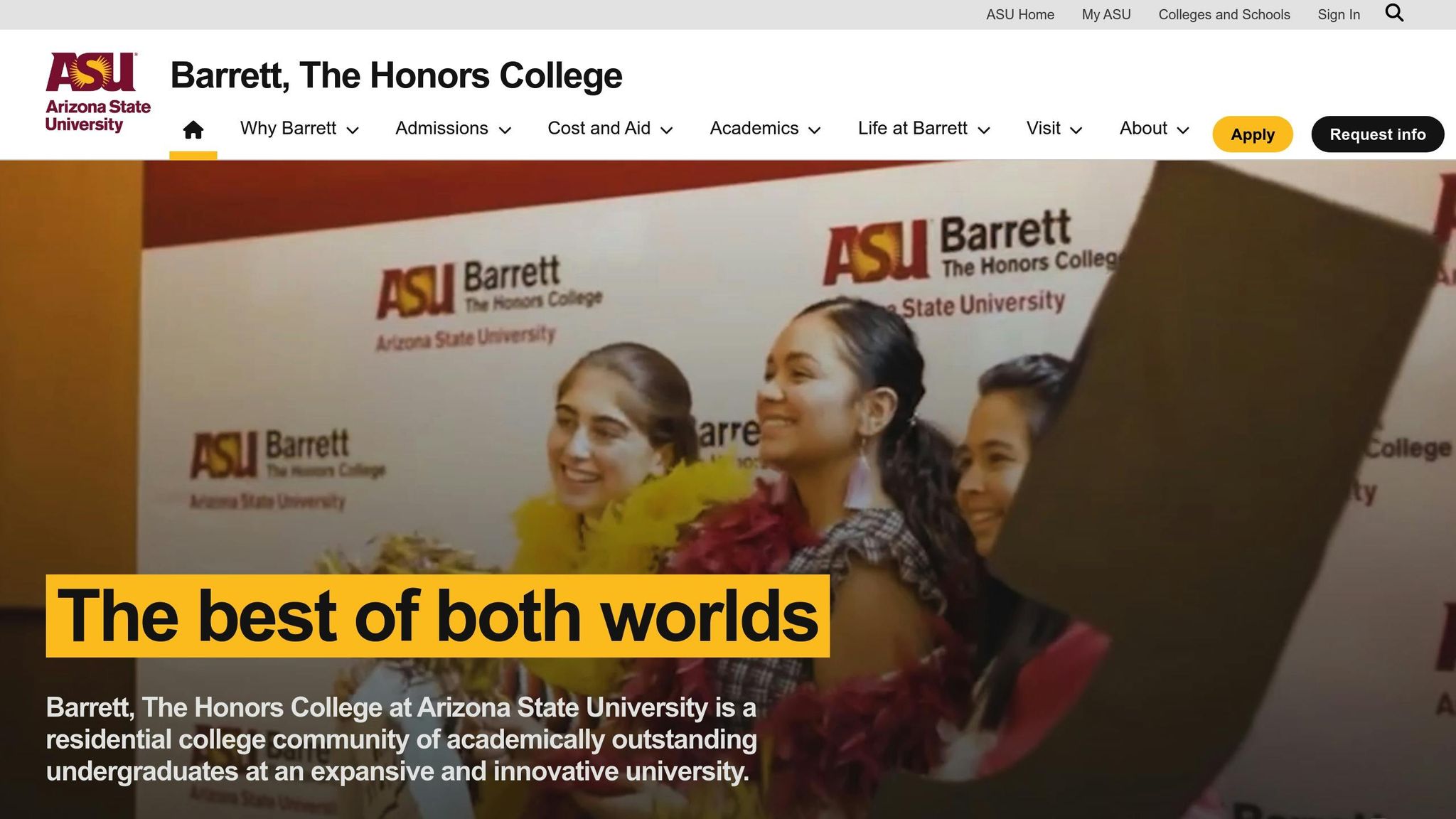
Barrett Honors College has tailored its admissions policies to better reflect the diverse experiences of applicants. For current and transfer students, the admissions process is entirely test-blind, while incoming first-year applicants have the option to submit test scores if they choose. Let’s break down how this approach works and what it means for prospective students.
What Test-Blind Means
A test-blind policy means that Barrett does not consider ACT or SAT scores at all - even if you submit them. This is different from a test-optional approach, where applicants can decide whether or not to include their scores, and those scores are considered if provided.
For current students and transfer applicants, Barrett's process is strictly test-blind. Standardized test scores are completely excluded from the evaluation process, focusing instead on other academic and personal achievements.
However, for incoming first-year students applying directly from high school or homeschool, the policy is test-optional. These applicants can self-report their ACT or SAT scores if they believe the scores strengthen their application. The difference here is simple: it’s entirely up to the student to decide whether to include test scores.
This dual approach acknowledges that students interact with standardized testing differently. For current and transfer students, their college coursework already provides a clear picture of their academic abilities, making test scores unnecessary.
What Barrett Reviews Instead of Test Scores
Without standardized test scores in the mix, Barrett takes a broader approach to evaluate applicants. Their admissions process focuses on a holistic review, considering multiple dimensions of each applicant’s academic and personal achievements.
Barrett places significant emphasis on your academic record, including coursework and any AP or IB scores, to gauge your readiness for rigorous college-level work. There’s no minimum GPA requirement; instead, your performance is evaluated within the context of your academic path, recognizing that every student’s journey is unique.
Beyond academics, the admissions team looks closely at factors like leadership, special talents, community involvement, personal achievements, and meaningful life experiences. Your essay plays a central role in this process, offering a chance to highlight your strengths, share your values, and demonstrate how you would contribute to the Barrett community. It’s your opportunity to show not just what you’ve accomplished, but who you are.
Why Barrett Adopted a Test-Blind Policy
Barrett’s test-blind approach reflects the belief that qualities like leadership, personal growth, and unique experiences are better indicators of a student’s potential than standardized test scores. By shifting the focus to these attributes, the college aims to create a more inclusive admissions process that values the whole person, not just a number on a test.
How to Write a Strong Personal Essay for Barrett Honors College
With Barrett's test-blind admissions policy, your personal essay takes center stage. Without standardized test scores in the mix, this essay is your chance to showcase who you are - your personality, values, and how you’d contribute to the honors community. It’s not just about listing achievements; the goal is to craft a narrative that highlights your intellectual curiosity, personal growth, and connection to Barrett's mission.
Understanding Barrett's Essay Prompts
Barrett’s essay prompts are designed to dig deeper than surface-level accomplishments. They’re not just asking, “What have you done?” but instead, “Who are you?” and “How do you think?” These prompts often ask you to reflect on challenges, pivotal moments, or experiences that shaped your perspective.
For example, if a prompt asks about a time you challenged a belief or idea, they’re not just interested in the event itself - they want to understand how you think critically and engage with complex ideas. Similarly, if they ask about a problem you’ve solved, they’re looking to see how you approach challenges and persevere through obstacles.
The best essays demonstrate intellectual humility - showing that you’re open to questioning your assumptions and learning from others. Barrett values students who approach learning with curiosity and a willingness to explore, not those who present themselves as having all the answers. Once you’ve understood the essence of the prompt, the next step is crafting a thoughtful and well-organized response.
How to Structure Your Essay
Start with a specific, vivid moment that grabs attention. Avoid generic statements and dive straight into a compelling detail: “As I stood in the community library, flipping through books on urban design, I realized how little I knew about the impact of public spaces on mental health.” This kind of opening immediately draws the reader in and sets the stage for your story.
Organize your essay around three key elements: the challenge, the action, and the growth. Begin by describing a specific challenge or question you faced, then explain the steps you took to address it. Most importantly, focus on how the experience transformed your perspective or approach. Barrett admissions officers are looking for evidence of intellectual growth and self-reflection.
Wrap up your essay by connecting your experience to your aspirations at Barrett. Be specific - don’t just say you want to “make a difference.” Instead, explain how your journey has prepared you to thrive in Barrett’s collaborative learning environment or how you’ll engage with its interdisciplinary opportunities. This not only ties your story together but also shows you’ve taken the time to understand what makes Barrett unique.
Showing Barrett Values in Your Story
Barrett places a high value on intellectual curiosity. Your essay should reflect a genuine excitement for learning and discovery. This doesn’t mean you need to have conducted groundbreaking research. It could be as simple as describing how a conversation with a teacher sparked your interest in renewable energy, leading you to explore the science behind solar panels and their impact on local communities.
Another key value is collaborative leadership. Rather than focusing on times you were “in charge,” highlight moments when you worked with others to achieve a common goal. For instance, you might write about organizing a neighborhood cleanup, where you coordinated with local officials, residents, and businesses to tackle environmental concerns.
Barrett also values the ability to think across disciplines, so consider sharing examples where you connected different fields of study. Maybe your love of art led you to explore how design influences user behavior in technology, or your passion for history inspired you to investigate its role in shaping modern political systems. These kinds of connections show you’re ready to embrace Barrett’s interdisciplinary approach.
Lastly, let resilience and adaptability shine through your story. Instead of explicitly stating, “This taught me resilience,” show how you navigated setbacks or adjusted your approach when plans didn’t work out. For instance, you might describe how you reworked a science project after an experiment failed, or how you found creative solutions when organizing a community event hit unexpected roadblocks.
Above all, be authentic. Barrett admissions officers read countless essays about awards and leadership roles, but what stands out are stories with genuine reflection. A thoughtful essay about helping in your family’s small business and learning about teamwork and problem-solving can be far more memorable than a generic list of achievements. Authenticity and reflection are what make your story resonate, not the size of the accomplishment. These values can also be woven into other parts of your application, like leadership roles or extracurricular activities.
sbb-itb-4c78c7f
Strengthening Other Parts of Your Application
Your essay might be the centerpiece of your application, but the additional materials you submit help paint a fuller picture of who you are. Each piece should align with the story you’re telling while highlighting different aspects of your personality and achievements.
Presenting Leadership and Community Work
Barrett places a strong emphasis on leadership and community involvement. Instead of just listing roles like "Student Council President" or "Club Captain", dive into the specifics of what you accomplished. Share how you took initiative, identified problems, and worked with others to create meaningful solutions. For instance, rather than only mentioning the number of volunteer hours you completed, describe a time when you spotted an inefficiency and collaborated with your team to fix it.
Numbers can help illustrate your impact, but don’t rely on them alone. Pair statistics with context and personal stories to show how your efforts made a difference. Highlight sustained contributions and teamwork. To strengthen this narrative further, ensure your recommendation letters reflect these qualities.
Getting Strong Recommendation Letters
Barrett requires two recommendation letters, with at least one coming from a teacher or professor who has taught you in class. Since these letters can’t be pulled from the Common App or other external platforms, you’ll need to directly request them through Barrett’s application system.
Start early - ideally six to eight weeks before the deadline. Mark Peltz notes that failing to give recommenders enough time can negatively affect the quality of your application.
Choose recommenders who can speak to different facets of your abilities. An academic recommender should highlight your intellectual curiosity and critical thinking, while a second recommender - like a mentor, supervisor, or community leader - can focus on your contributions outside the classroom.
When you ask someone to write a letter, make their job easier by providing a current resume, a summary of your key achievements, and an overview of your goals. Share information about Barrett’s core values, such as critical thinking, leadership, and community engagement . Barrett’s system also lets you track the status of your letters and send reminders as deadlines approach. Make sure your resume and short-answer responses reinforce the same strengths your recommenders will highlight.
Writing Your Resume and Short Answers
Your resume should work hand-in-hand with your essay and recommendation letters, offering clear, concise details about your achievements. Aim for a one-page document that uses action verbs and highlights measurable outcomes. For instance, instead of saying you were part of a research team, explain how your contributions - like presenting findings or conducting experiments - helped advance a project.
Arrange your resume to showcase experiences that align most closely with your academic interests. For the short-answer questions, focus on being specific and genuine. These responses are your chance to provide additional insight into your experiences and character. Whether you’re describing a challenge you overcame or a moment that shaped you, emphasize your problem-solving skills and resilience. Keep Barrett’s interdisciplinary focus in mind, ensuring your answers reflect the qualities they value most.
Conclusion: Your Path to Barrett Without Test Scores
Barrett Honors College's test-blind policy has shifted the focus of applications, placing greater importance on your personal story, academic journey, and leadership experiences. Without SAT or ACT scores as part of the equation, your narrative takes center stage - giving you the chance to highlight what truly defines you.
Your essay is your most powerful tool. Use it to share the moments that have shaped your character, the obstacles you've overcome, and how your values align with Barrett's emphasis on intellectual curiosity and community involvement. This is where you can let your individuality shine.
Barrett’s holistic review process ensures that every aspect of your application contributes to a comprehensive picture of who you are. Whether it’s your leadership roles, community contributions, or academic accomplishments, these elements demonstrate qualities that standardized tests simply can’t measure. Highlight efforts that have made an impact, both on yourself and those around you.
Additionally, strong recommendation letters and a well-crafted resume provide admissions officers with valuable insights into your character and potential. These components reinforce your readiness to thrive in Barrett’s dynamic academic environment.
With over 7,100 students enrolled and more than 20,000 alumni, Barrett continues to attract a diverse and high-achieving student body. Its holistic admissions approach ensures that students with unique stories and meaningful contributions are given the opportunity to join this thriving community.
In this test-blind landscape, your ability to craft a compelling narrative, present your achievements thoughtfully, and demonstrate alignment with Barrett’s values is key. This is your opportunity to let your story take the spotlight - showcasing your growth, resilience, and readiness to contribute to Barrett's vibrant intellectual community.
FAQs
How will Barrett Honors College's test-blind policy affect my application review?
Barrett Honors College has a test-blind admissions policy, meaning your SAT or ACT scores won’t be considered. Instead, the admissions team takes a comprehensive look at your application, focusing on elements like your essays, GPA, extracurricular activities, and personal achievements.
This approach gives you the chance to highlight who you are beyond numbers. A thoughtful essay and a well-rounded application can make a strong impression, helping you stand out without relying on standardized test scores.
How can I write a strong personal essay for Barrett Honors College at ASU?
When writing your personal essay for Barrett Honors College, the key is to share your story in a way that feels genuine and personal. Think about the moments that have influenced your values, sparked your passions, or shaped your goals, and tie those experiences to what makes you a strong candidate for the honors program.
Be sure to address the prompts directly, weaving in specific examples that give depth to your narrative and help the reader connect with your journey. Take the time to proofread your essay thoroughly - clarity and a polished presentation are just as important as the content itself. The most memorable essays are those that feel honest and leave a lasting impression.
How can I make my resume and recommendation letters stand out without including test scores?
To make your application stand out without test scores, focus on emphasizing your academic successes, leadership experiences, and personal qualities. Showcase your participation in extracurricular activities, community service, or unique projects that demonstrate your skills, dedication, and passion.
For recommendation letters, ask your recommenders to include specific examples that highlight your problem-solving abilities, original thinking, and determination. These insights provide a deeper understanding of your character and align with ASU's holistic admissions process. Customize your resume and letters to highlight what sets you apart and how you’ll bring value to the Barrett Honors College community.