
SAT vs ACT for Computer‑Science Majors in 2025
Choosing between the SAT and ACT in 2025? Here's what you need to know:
- SAT: Now fully digital, featuring adaptive questions and 50% of its score focused on math. Offers more time per question and includes a formula sheet.
- ACT: Introduced an optional Science section (April 2025) to test data analysis skills. Math accounts for one-third of the score and includes advanced topics like matrices and logarithms.
Quick Comparison
| Feature | SAT | ACT |
|---|---|---|
| Math Weight | 50% of total score | ~33.3% of total score |
| Science Section | Integrated into other areas | Dedicated Science section |
| Advanced Math Topics | Limited | Includes matrices & logs |
| Timing | More time per question | Faster-paced |
| Format | Adaptive (digital) | Linear (non-adaptive) |
| Calculator | Built-in Desmos option | Personal calculators only |
The SAT suits students who excel in algebra and prefer a slower pace, while the ACT is ideal for quick thinkers with strengths in geometry and advanced math. Both tests are accepted by top CS programs, so choose based on your strengths and target schools.
SAT vs ACT: Core Differences for STEM Students
Math Content Comparison
When it comes to math, the SAT and ACT take noticeably different approaches. On the SAT, math accounts for 50% of the total score, emphasizing its importance. In contrast, the ACT dedicates roughly a third of its score to math, but it also covers a broader range of advanced topics like matrices, logarithms, and graphs of trigonometric functions - none of which appear on the SAT.
Geometry is another area where the two tests diverge significantly. The ACT devotes 30% to 45% of its math section to geometry, while the SAT keeps it under 10%. Here's a quick breakdown of how the math topics compare:
| Topic | SAT Math | ACT Math |
|---|---|---|
| Algebra Focus | Primary focus | Balanced with other topics |
| Geometry Content | Less than 10% | 30–45% |
| Trigonometry | Less than 5% | About 7% |
| Advanced Topics | Limited | Includes matrices & logarithms |
| Formula Sheet | Provided | Not provided |
Beyond math, the ACT sets itself apart with a dedicated science section, which adds another layer of distinction between the two tests.
ACT Science Section Overview
The ACT includes a Science section designed to evaluate a student's ability to interpret and analyze data. However, don't let the name fool you - it’s less about testing scientific knowledge and more about reading and reasoning skills. Allen Koh, CEO of Cardinal Education, puts it this way:
"The science section is more of an applied reading section than a science section... We don't train people in science for the science section of the ACT, we train people where to find the answers and the answers of how they're asking these lab setup questions".
This section consists of 40 questions to be completed in 35 minutes, focusing on:
- Interpreting data from charts and graphs
- Analyzing experimental setups
- Evaluating scientific hypotheses
While the SAT doesn’t have a standalone science section, it incorporates scientific reasoning and data analysis into its Reading, Writing, and Math sections.
Test Timing and Question Format
Big changes are coming to both tests in 2025, with updates to timing and question formats. The ACT will shorten its core testing time from 195 minutes to 125 minutes, giving students about 67 seconds per math question - a tighter timeframe compared to the SAT, which allows around 1 minute and 35 seconds per math question.
Here’s a snapshot of the key differences in timing and format:
- The ACT will feature 44 fewer total questions, with its Math section shrinking from 60 to 45 questions.
- Math questions on the ACT will offer four answer choices instead of five.
- The ACT will follow a linear, non-adaptive format.
Meanwhile, the SAT will retain its digital adaptive testing format, where question difficulty adjusts based on previous answers. This structure rewards students who excel at methodical problem-solving - a skill that’s particularly valuable for those pursuing computer science or other STEM fields.
Score Systems and Equivalents
Scoring Basics
The SAT and ACT operate on distinct scoring systems. The SAT scores range from 400 to 1600, divided into Reading & Writing (200–800) and Math (200–800) sections. On the other hand, the ACT uses a 1–36 scale, which represents the average of four sections: English, Math, Reading, and Science.
"Statistically, it is easier to get a perfect score on the ACT. The content for each test is different. However, in general, ACT questions tend to be more straightforward, whereas SAT questions tend to be trickier".
Achieving a perfect score is rare: fewer than 0.1% of SAT test-takers score 1600, while about 0.25% of ACT test-takers earn a 36. To help compare scores, here’s a quick equivalency chart:
| SAT Score | ACT Score |
|---|---|
| 1600 | 36 |
| 1560–1590 | 35 |
| 1520–1550 | 34 |
| 1490–1510 | 33 |
| 1450–1480 | 32 |
| 1420–1440 | 31 |
These conversions are particularly useful when evaluating scores for competitive Computer Science (CS) programs.
CS Program Score Requirements
"No college has a preference between the two tests...They're like two children. They love them both the same. They just want them to be good".
Top-tier CS programs typically expect applicants to fall within specific score ranges, as shown below:
| Program Selectivity | SAT Range | ACT Range |
|---|---|---|
| Highly Selective | 1500–1580 | 34–36 |
| Very Selective | 1450–1500 | 32–34 |
| Selective | 1390–1450 | 30–32 |
For example, in August 2023, one applicant achieved a 1550 on the paper SAT (750 in English, 800 in Math) and a 1510 on the digital PSAT (750 in English, 760 in Math). This positioned them well for schools with SAT ranges of 1500–1580.
Even for institutions that are test-optional, many still maintain separate score thresholds for merit scholarships. Since SAT and ACT scoring patterns differ, selecting the right test and preparing effectively can make a significant difference in admissions outcomes.
Test Selection Factors for CS Students
Problem-Solving Assessment Methods
The SAT leans heavily on analytical and multi-step reasoning, while the ACT prioritizes straightforward scientific problem-solving approaches.
"The SAT and ACT are not just assessments of academic knowledge but also of a student's ability to reason and think critically." - Lumiere Education
For example, the SAT Math section challenges students with graph interpretation and multi-step problem-solving tasks. On the other hand, the ACT's Science section emphasizes interpreting scientific data and drawing logical conclusions.
When it comes to computer science (CS) students, each test has its own strengths:
| Aspect | SAT Approach | ACT Approach |
|---|---|---|
| Data Analysis | Focuses on graph and chart interpretation | Emphasizes scientific data interpretation |
| Math Depth | Centers on logic-based problem solving | Covers broader mathematical concepts |
| Question Style | Requires multi-step reasoning | Favors direct problem solving |
| Time Management | Allows more time per question | Demands faster pacing and efficiency |
Grasping these problem-solving styles is essential, especially when considering how calculator policies influence test strategies.
Calculator Rules and Impact
Calculator policies play a significant role in shaping how students tackle quantitative sections.
"Students may use their own acceptable calculator on test day or take advantage of the graphing calculator built directly into the testing application." - College Board
Here’s a breakdown of how calculator rules differ between the SAT and ACT:
| Feature | SAT | ACT |
|---|---|---|
| Calculator Access | Offers built-in Desmos and personal calculator options | Allows personal calculators only |
| Disallowed Calculators | Prohibits QWERTY keyboard calculators | Prohibits calculators with Computer Algebra Systems |
| Math Section Format | Permits calculator use for all questions | Limits calculator use to specific sections |
| Question Design | Some questions are better solved without a calculator | All problems can be solved without one |
The SAT's built-in Desmos calculator eliminates concerns about technical issues or approval. Conversely, students who are more comfortable with their own scientific calculators might find the ACT format more appealing.
Ultimately, the choice between the two tests often boils down to a student's comfort level with calculators. Those familiar with Desmos may lean toward the SAT, while students who excel with traditional scientific calculators might prefer the ACT.
SAT vs. ACT: Key Changes in 2025 & How to Choose the Right Test for You | Tutor Doctor
sbb-itb-a0f4a21
Test Selection Guide
This guide simplifies the decision-making process for computer science majors trying to choose between the SAT and ACT, building on the comparisons outlined earlier.
Math Focus Assessment
The SAT and ACT place different levels of emphasis on math topics, which can influence their suitability for aspiring computer science students:
| Math Component | SAT Focus | ACT Focus |
|---|---|---|
| Algebra | Primary | Secondary |
| Geometry | Limited | Extensive |
| Advanced Topics | Data Analysis | Trigonometry & Matrices |
If you're strong in algebra and data analysis, the SAT may be the better option. On the other hand, if your skills lean toward geometry and advanced math concepts like trigonometry and matrices, the ACT could be a stronger fit.
Time Management Considerations
Your pacing style plays a critical role in determining which test aligns with your strengths. Here's a breakdown of time per question for each test:
| Section Type | SAT Time/Question | ACT Time/Question |
|---|---|---|
| Math | 95 seconds | 67 seconds |
| Reading | 51 seconds | 54 seconds |
| Writing/English | 51 seconds | 42 seconds |
| Science | N/A | 60 seconds |
The SAT allows more time per question, which benefits students who prefer a methodical approach. In contrast, the ACT is better suited for quick thinkers who can make decisions under tighter time constraints.
CS Program Requirements
For Fall 2025 admissions, keep these key considerations in mind:
-
Testing Policies
- Many leading computer science programs now require or strongly recommend standardized test scores.
- Some schools use these scores not only for admissions but also for awarding merit-based scholarships.
-
Program Alignment
- Research the current requirements for your target schools.
- Check if specific math scores are emphasized for admission.
- Determine whether certain test components, like data analysis, are favored by the program.
-
Selection Strategy
- Match the test to your strengths in algebra or geometry.
- Consider your natural pace for answering questions.
- Align with the requirements of your preferred schools.
- Factor in how much time you have available for preparation.
For most students aiming for a computer science degree, excelling in algebra and data analysis is particularly beneficial, as these skills are directly applicable to many CS courses.
With your test choice in mind, you're ready to take the next steps in preparing for success.
Next Steps
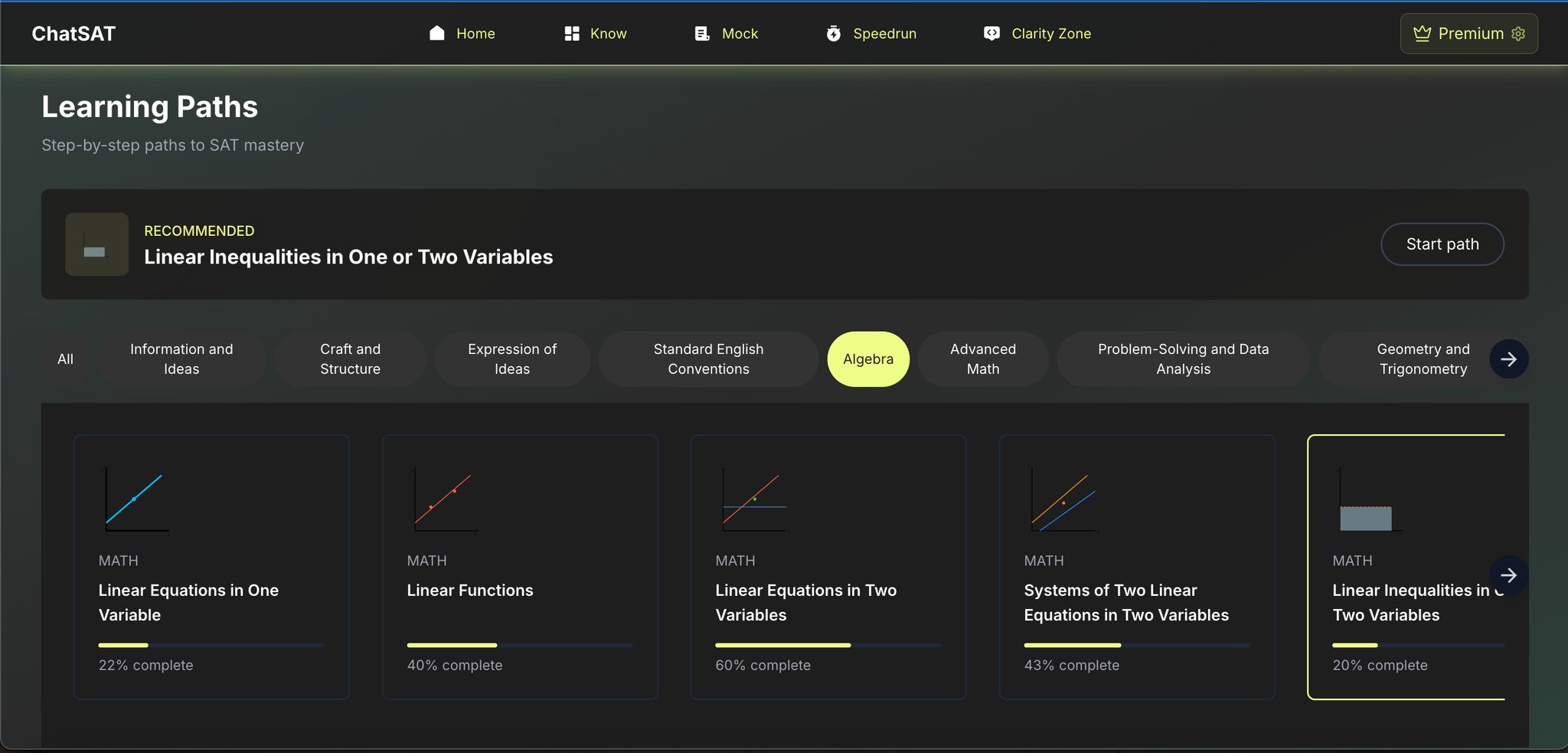
Kick off your test prep journey with ChatSAT's learning platform, designed specifically for computer science majors.
Personalized Assessment
Begin with an adaptive diagnostic test to establish your starting point. From there, ChatSAT's AI Study Director crafts a custom study plan that prioritizes data analysis and algebraic reasoning for SAT prep, as well as advanced math and scientific reasoning for the ACT.
The platform’s smart review system constantly evaluates your progress, pinpointing areas where you can improve the most and adjusting your practice materials in real time.
Focused Practice Strategy
Zero in on the critical areas for computer science-focused tests:
| Practice Area | Key Benefits |
|---|---|
| Adaptive Tests | Tailored questions that match your skill level |
| Domain Practice | Intense focus on STEM-related topics |
| Mock Exams | Simulated full-length tests with time limits |
| Performance Analytics | Real-time feedback and progress tracking |
Incorporate these into your study routine to stay on track and maximize your results.
Structured Study Timeline
Organize your preparation with this streamlined timeline:
1. Initial Phase (1-2 months)
Dive into core concepts and problem-solving techniques. Adaptive assessments from ChatSAT provide instant feedback, helping you build a solid foundation.
2. Intensive Practice (2-3 months)
Shift your focus to advanced topics and timed exercises. Use the platform’s analytics to uncover performance trends and refine your skills in specific areas.
3. Final Review (1 month)
Wrap up with full-length practice tests and targeted reviews of weak spots. ChatSAT’s personalized paths adapt as you progress, ensuring you’re fully prepared for test day.
Try ChatSAT’s free trial to explore its adaptive features. Full access costs $29.99 per month, offering a comprehensive toolkit to help you achieve your best score on the SAT or ACT.
FAQs
What do the 2025 changes to the SAT and ACT mean for computer science majors?
Changes to the SAT and ACT for 2025: What Students Need to Know
Big updates are coming to the SAT and ACT in 2025, and they could be a game-changer for students eyeing computer science programs. One major shift? The ACT will make its science section optional. This change lets students zero in on math and reading - two areas that matter most for STEM-focused applicants. The SAT, on the other hand, will stick to its current structure, continuing to emphasize math, evidence-based reading, and writing, without adding a science section.
Both exams are also getting shorter and more streamlined. The SAT is now fully digital and adaptive, which could help reduce test fatigue and make the process more accessible. This is great news for students juggling the intense workload of STEM courses. These updates aim to make standardized tests less stressful and more aligned with the skills tech-minded students want to showcase, especially in quantitative and analytical areas.
How do I decide between the SAT and ACT if I want to major in computer science at a top-tier school?
When deciding between the SAT and ACT for a computer science major, it's essential to consider your personal strengths and how each test aligns with them. The SAT leans heavily on math and evidence-based reading and writing, making it a solid choice if you're confident in those areas. On the other hand, the ACT includes a science section that evaluates data analysis and interpretation - skills that can be particularly relevant for STEM students.
To figure out which test suits you best, start by taking a full-length practice test for both. This will help you compare your performance and determine which format feels more natural. It's also a good idea to research the admissions preferences of the computer science programs you're interested in. Some schools might lean toward one test or provide guidance on which exam aligns better with their criteria.
In the end, choose the test that plays to your strengths and positions you as a standout candidate in the tech field.
How does the ACT’s inclusion of advanced math topics impact its suitability for students who are strong in math compared to the SAT?
The ACT dives into advanced math areas such as trigonometry and precalculus, whereas the SAT leans more heavily on algebra, problem-solving, and data analysis. This makes the ACT a great option for students who thrive in math and want to showcase a wider range of skills - something that can be especially appealing for STEM-focused college applications.
If you're comfortable with higher-level math concepts, the ACT could better emphasize your strengths. This might give you an edge in competitive admissions, particularly for programs like computer science or other tech-related fields.