
SAT Standard English Conventions 2025: 22 Rules That Cover that additional 150 points
Why This Matters

On the digital SAT, about 12–15 questions in Reading & Writing test Standard English Conventions — grammar, punctuation, and sentence structure rules of formal written English.
These are the most predictable SAT questions. Master the rules here, and you can lock in easy, fast points that lift your score.
This guide covers every single concept the SAT tests in this domain — from subject–verb agreement to participial phrases, sentence boundaries, and punctuation mastery — plus examples, common traps, and strategies.
sbb-itb-4c78c7f
Quick-Reference Rule Table
| Rule | What to Remember | Example | Common SAT Trap |
|---|---|---|---|
| Subject–Verb Agreement | Verb matches subject in number | The bouquet is lovely. | Prepositional phrase distracts: The bouquet of roses are lovely ❌ |
| Pronoun Agreement | Pronoun matches noun in number and clarity | Each student finished his or her essay. | Using “their” with singular noun without clarity |
| Pronoun Case | Subject pronouns for doers, object pronouns for receivers | She and I went. / They saw me. | “Me and her went” ❌ |
| Verb Tense Consistency | Keep tenses consistent unless time changes | He studied before he moved. | Unnecessary tense shift mid-sentence |
| Subjunctive Mood | Use “were” in hypotheticals | If I were you… | Writing “If I was you” ❌ |
| Modifier Placement | Keep modifiers next to what they describe | Running fast, the athlete won. | Dangling: Running fast, the race was won… ❌ |
| Participial Phrases | Adjective phrases starting with -ing/-ed must attach to the right noun | Excited by the news, she smiled. | Attaching to wrong noun |
| Parallel Structure | Items in lists/comparisons match in form | Hiking, biking, swimming | Hiking, biking, to swim ❌ |
| Sentence Boundaries | Fix run-ons, fragments, comma splices | I left; it was late. | Comma splice: I left, it was late. ❌ |
| Commas | Lists, intros, nonessential info | After dinner, we left. | Random comma between subject and verb |
| Semicolons | Join two complete sentences | I read; I learned. | Using before dependent clause |
| Colons | Full sentence before colon | She had one goal: victory. | Colon after incomplete thought |
| Dashes | One dash = colon; two dashes = parentheses | I love one sport – soccer. | Mixing dash with comma |
| Apostrophes | Possession or contraction | The student’s book | Mixing plural with possessive |
| Who / Whom | Who = subject, whom = object | The coach who leads… | Using “whom” as subject |
| Which / That | Which = nonrestrictive (with commas), That = restrictive (no commas) | The car, which is red… | Wrong clause type |
| Correlative Conjunctions | Either/or, neither/nor → keep parallel | Either running or biking | Mixing forms |
| Comparatives & Superlatives | -er/-est or irregular (better, best) | She is better than him | Double comparative: more better ❌ |
| Conjunctive Adverbs | Need semicolon/period before them when joining clauses | I studied; however, I was tired. | Comma splice with “however” |
Rule-by-Rule Breakdown with SAT Focus
1. Subject–Verb Agreement
- Singular subject → singular verb
- Plural subject → plural verb
- Ignore words between subject and verb (The box of ornaments is heavy.)
- Collective nouns (team, committee) are singular.
- “Each” / “Every” → singular
- With “or”/“nor” → match verb to nearest subject.
Trap:
The team of engineers were excited. ❌
Correct: The team of engineers was excited. ✅
2. Pronoun Agreement
- Match number and person with antecedent.
- Keep reference clear — if two nouns could be the antecedent, replace pronoun.
Trap:
When Mia spoke to Ava, she was upset. (Who?) ❌
3. Pronoun Case
- Subject pronouns: I, he, she, we, they, who
- Object pronouns: me, him, her, us, them, whom
- Test: Remove other noun → “I went” ✅, “Me went” ❌.
4. Verb Tense Consistency
- Match tense to time clues.
- Keep consistent unless timeline changes.
- Past perfect (had + verb) for earlier past action.
Example:
By the time she arrived, we had eaten.
5. Subjunctive Mood
- Use “were” for unreal hypotheticals: If I were rich…
- Use base verb after suggestions/demands: I recommend that he study harder.
6. Modifier Placement
- Keep modifiers close to the noun they describe.
- Dangling modifier: modifier at start not followed by correct noun.
Example:
Walking down the street, the trees were beautiful. ❌
Walking down the street, she admired the trees. ✅
7. Participial Phrases (FULL)
- What they are: Phrases starting with a present participle (-ing) or past participle (-ed, irregular forms) acting as adjectives.
- Purpose: Add detail about a noun.
- Rule: Must be placed next to the noun they modify.
Present participle example:
Excited by the results, the scientist shared her findings.
Past participle example:
Shocked by the news, he sat in silence.
Common SAT traps:
-
Dangling participle:
Hiking the trail, the birds chirped loudly. ❌ (The birds didn’t hike.)
Correct: Hiking the trail, we heard birds chirp loudly. ✅ -
Misplaced participle:
She served sandwiches to the children on paper plates. (Ambiguous — children on plates?)
Correct: She served sandwiches on paper plates to the children.
SAT tip:
If an intro phrase starts with an -ing/-ed word, check that the subject right after it logically performs that action.
8. Parallel Structure
- Lists: same grammatical form
- Comparisons: compare like with like
Example:
✅ I like swimming, biking, and running.
❌ I like swimming, biking, and to run.
9. Sentence Boundaries
- Fragment: Missing subject/verb → Because it rained. ❌
- Run-on: Two sentences without proper connection → It rained I stayed inside. ❌
- Comma splice: Two sentences joined by just a comma → It rained, I stayed inside. ❌
Fixes:
- Period
- Semicolon
- Comma + FANBOYS (for, and, nor, but, or, yet, so)
10. Commas
- Separate items in list
- After introductory phrase: After school, we studied.
- Around nonessential info: My brother, a doctor, lives in NYC.
- ❌ Never between subject and verb without reason.
11. Semicolons
- Join two independent clauses without conjunction
- Before conjunctive adverbs (however, therefore) when joining sentences.
12. Colons
- Full sentence before colon
- Introduces list, explanation, or quote
13. Dashes
- One dash = colon in function
- Two dashes = set off extra info
- Keep punctuation consistent — don’t mix dash with comma.
14. Apostrophes
- Singular possessive: add ’s → the cat’s toy
- Plural possessive: add s’ → the cats’ toys
- Irregular plural possessive: ’s → children’s books
- Contractions: it’s = it is; its = belongs to it
15. Who / Whom
- Who = subject of verb
- Whom = object of verb/preposition
- Test: Replace with he/him → he = who, him = whom.
16. Which / That
- Which → nonrestrictive, needs commas: The car, which is red, is fast.
- That → restrictive, no commas: The car that is red is fast.
17. Correlative Conjunctions
- Either/or, neither/nor, not only/but also → keep elements parallel
- Verb agreement matches nearest subject in either/or or neither/nor structures.
18. Comparatives & Superlatives
- Two items → comparative (-er, more)
- Three+ items → superlative (-est, most)
- Irregulars: good → better → best
- ❌ Never double: more better
19. Conjunctive Adverbs
- Words like however, therefore, moreover, consequently
-
When joining clauses: semicolon before, comma after
I studied; however, I was tired.
20. Adjective vs. Adverb
- Adjectives describe nouns/pronouns
- Adverbs describe verbs, adjectives, adverbs
- ❌ He runs quick → ✅ He runs quickly
21. Ellipsis in Comparisons
- Maintain grammatical completeness when words are omitted.
I run faster than she [runs].
22. Pronoun Consistency
- Stick with “one” or “you” consistently
One should do one’s work.
You should do your work.
Question Types on the SAT
- Boundaries – punctuation differences between clauses
- Agreement – verb or pronoun changes
- Modifier Order – reordering phrases
- Punctuation-Only – same words, different marks
- Combination – joining sentences without errors
Common SAT Grammar Traps
- Choosing what “sounds right” from speech
- Missing the true subject (due to extra words)
- Lone comma between complete sentences (comma splice)
- Apostrophe misuse for plurals/possessives
- Parallelism mismatches in lists or comparisons
5-Step Strategy
- Spot the rule by comparing choices.
- Read the full sentence for clues (timeframe, number, meaning).
- Eliminate clear errors (fragments, run-ons, mismatches).
- Check remaining for subtle traps.
- Plug in & re-read to confirm correctness.
Quick SAT-Style Practice
Q1
Each of the athletes (was / were) excited.
✅ was (Each = singular)
Q2
Excited by the news, (the party began / she began the party) without delay.
✅ she began the party (fixes dangling participle)
Q3
I enjoy reading, painting, and (to cook / cooking).
✅ cooking (parallel gerunds)
Grammar Feedback System
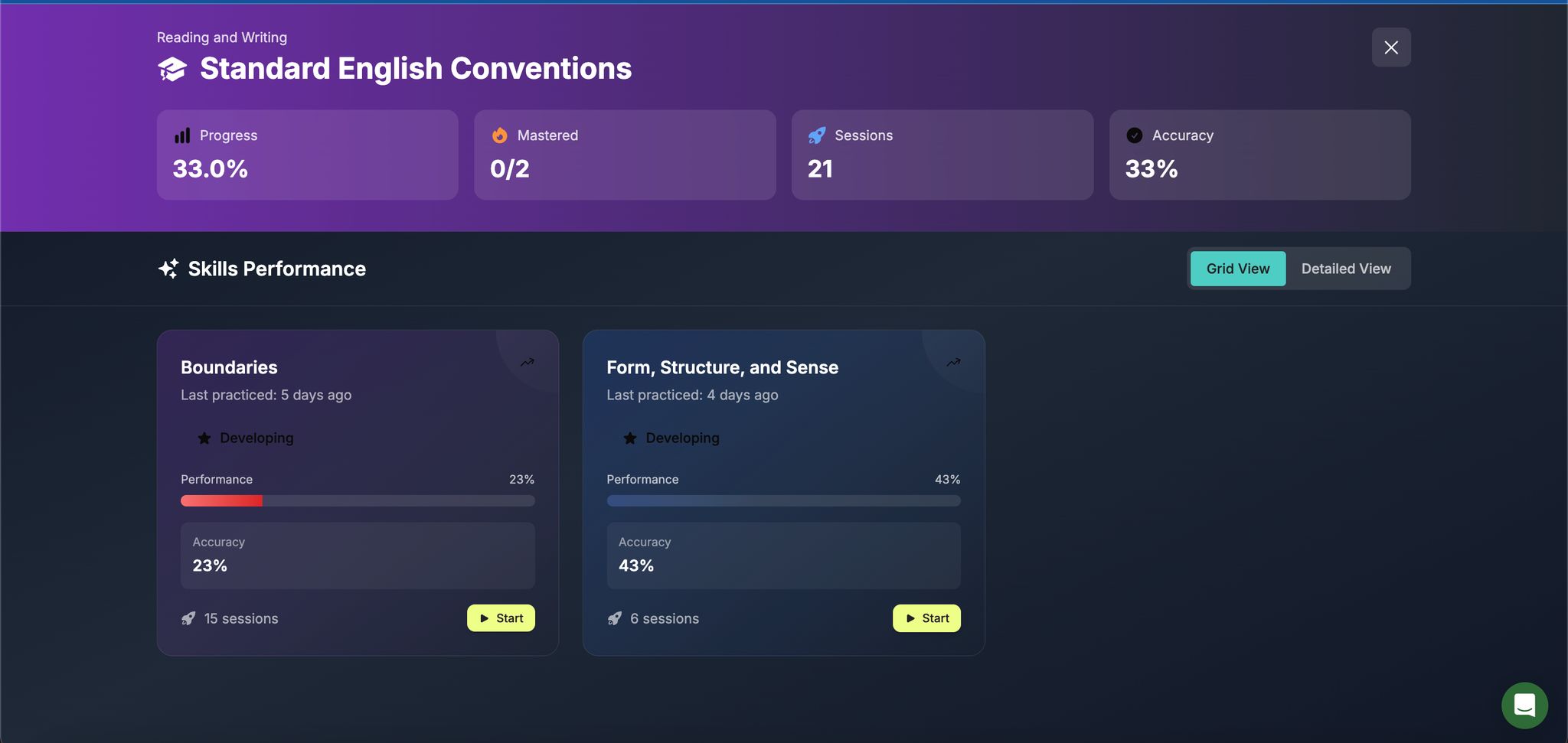
Unlike static prep books, ChatSAT adapts to your performance in real time. When you miss a subject–verb agreement question, it doesn’t just give you the right answer — it explains why the correct choice works, points out the grammar pattern behind it, and then gives you similar SAT-style questions until you can get them right without hesitation. You’ll see exactly which rules you’ve mastered and which still need work.
With built-in timed drills, full-length adaptive practice tests, and an instant feedback engine that mirrors the official SAT format, ChatSAT turns learning grammar from a slow memorization grind into an efficient, results-driven process. Many students using ChatSAT see their Reading & Writing score jump by 50–100 points in just a few weeks because they’re not just practicing — they’re practicing the right way. If you want to walk into test day knowing you’ve seen every rule the SAT can throw at you, ChatSAT is your shortcut.
Final Takeaways
- Memorize these rules — the SAT repeats them.
- Practice in the official Bluebook app for real question styles.
- Focus on accuracy first, then speed.
- For maximum points: know the common traps and check for modifier placement every time.